Login vs Sign In
If you develop web apps or design web app interfaces there is one link you will inevitably always have. This link allows the user to log in, or sign in, to the website. But what is the correct terminology to use?
A look at the big sites
Let’s look at the web’s top web sites and applications to see what terminology they use.
Login: 1 Sign in: 0
Gowalla

Login: 1 Sign in: 1
Foursquare

Login: 2 Sign in: 1
Basecamp

Login: 2 Sign in: 2

Login: 2 Sign in: 3

Login: 2 Sign in: 4
eBay
Login: 2 Sign in: 5
Login: 2 Sign in: 6
Last.fm
Login: 3 Sign in: 6
SlideShare

Login: 4 Sign in: 6
Vimeo

Login: 4 Sign in: 6 Log In: 1
Spotify

Login: 4 Sign in: 6 Log In: 2
Definitions
Looking at other websites there doesn’t seem to be anything decisive – there’s a mix of login, sign in and log in.
What does each term mean?
Definition of login (from Dictionary.com)
the act of logging in to a computer, esp. a multiuser computer or a remote or networked computer system
Definition of sign in (from Dictionary.com)
an act, an instance, or a time of signing in
No conclusive answer here either, both work fine.
How I work
I use login.
The reason for this is because I tend to keep sign up and login links available at all times, on all pages. These links are usually top right and next to each other e.g. Lookaly.com

Here’s a heatmap visual of this area.

Using the term ‘login’ means that at a glance the user can instantly tell the difference between ‘Login’ and ‘Sign up’.
By using ‘Sign in’ the user has to take a second or two to read the words to identify between the two and there’s more chance of them clicking the wrong link.
Of course this theory only comes into effect if you have a sign up and login link beside one another. As you can also see from the heatmap above, this sign up link doesn’t get a lot of clicks and most of the sign ups come from other call-to-actions throughout the site.
Words of wisdom from Twitter
I put the question out to my Twitter followers and got some good responses.
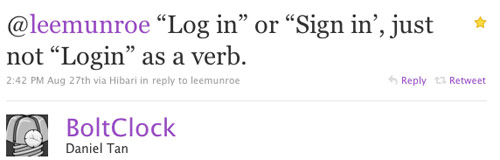
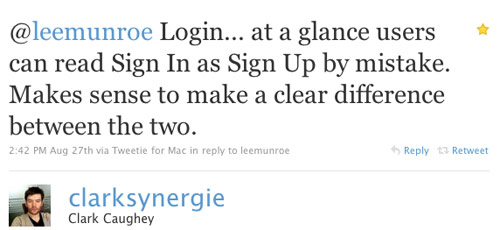
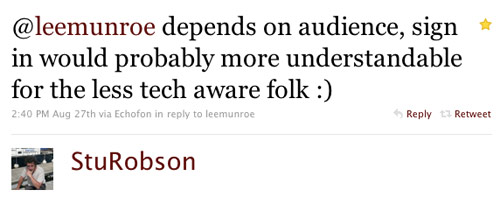
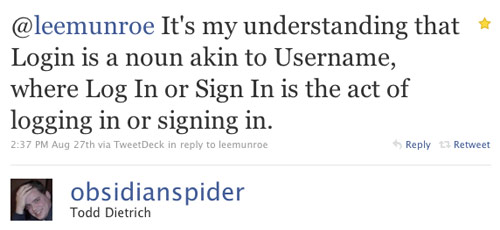


What do you think?
It’d be great to hear your verdict to see if you have a good reason to use one version over the other.
Use the poll below to cast your vote and please follow up with any comments or advice you have.
[polldaddy poll="3764061"]
Related articles
34 Appreciated Comments
Have a comment? Tweet @leemunroe and I'll be glad to respond.


On the , HammHetfield said:
As a foreigner, “login” looks easier to me. I’m always confuse when I have a “Sign in” and a “sign up” links beside…
“Written with love from Lee Munroe.”
Reading with love too.
PS : Maybe the “Notify me followup comments” should not be on by default, don’t know just an idea, I thought it was the “I aggre to the long rules nobody reads”.
On the , cmckelvey said:
‘Sign up’ seems Americanised? I use ‘Register’ and ‘Sign In’ – just a personal preference. Logging in and Logging out are probably more correct when used on the web. Signing in/out is none web idea.
I really don’t think it matters. As long as it’s clear and not hidden!
On the , Alan in Belfast said:
How’d you generate the heatmap? Looks like a useful UI usability technique …
On the , Chris Johnson said:
Personally I prefer “Sign In”. But it really depends on the application. I have a gripe at the terminology used when it comes to “Login”, I feel it should say “Log In” because to me the latter is a call to action where as “Login” is more of an entity or an object (Login Details) that users would store or use.
On the , Rich Palmer said:
I would be inclined to use ‘Login’ or ‘Log In’ personally. However, when thinking about the theory of it, ‘Sign In’ could be easily paired with ‘Register’ rather than ‘Sign Up’ to make sure users don’t click the wrong link by mistake.
Like many things, I think it just comes down to personal preference or whichever term suits the audience best – I’d have to agree that ‘Login’ is more suited to the ‘techy people’.
On the , Jonny Campbell said:
I have to agree with HammHetfield, the thing that annoys me the most about login forms is to find ‘Sign In’ and ‘Sign Up’ together. It’s even worse when these are switched around so that ‘Sign Up’ comes before ‘Sign In’.
I’d prefer to use ‘Login’ and ‘Sign Up’.
On the , Elisabeth Irgens said:
I like Amazon’s way of merging the ‘Log In’ with the ‘Sign Up’.
You fill out your e-mail, then choose what applies of:
[ ] No, I am a new customer.
[ ] Yes, I have a password: ________
On the , John Camacho said:
I like Login | Register
I think its a really small issue though – a matter of personal preference.
On the , Dani said:
Login is an adjective or noun; log in is a verb. As in, “please give me your login credentials so that I can log in to your account.” Would you use “signin” all as one word?
On the , Lee said:
All good feedback. Looks like a matter of preference really. Be interesting to see A/B test results from someone like Google.
One issue that crops up is that “Login” isn’t a verb, so it should be “Log in”.
Although this is true, do links have to be labelled with verbs? e.g. I know “Home” will bring me to the homepage but that doesn’t mean I’ll label it “Visit the homepage”
What if you thought about it in a way that ‘login’ brings you to a login screen/page, which is where you ‘log in’?
@cmckelvey: Register vs Sign up – that can be the next debate ;-)
@Alan in Belfast: These are from http://www.reinvigorate.net (fantastic product). http://www.crazyegg.com/ also very useful
@Elisabeth Irgens: Agreed, that is a really nice way of logging in and signing up.
On the , ocube said:
Ive always prefered login myself for the reasons given, no need to make the user think for a sec whether they are signing in or signing up again.
On the , Jim Munro said:
Ah, you always pick these controversial topics. :)
I was wondering if perhaps Sign In maybe more appropriate where users are slightly less “technical”, but the sampling of sites above doesn’t seem to support that.
Following the “Don’t Make Me Think” logic, perhaps placement is more important than terminology. I always look for a login link in the same place, but I don’t really care what you call it.
On the , Jonathan said:
What is the problem that this discussion is supposed to solve? Is there some evidence that people might not understand, say, “log in” as opposed to “sign in”? There appears to be none, ergo there is no usability problem.
As long as people understand both terms, then there’s no point in navel-gazing about which to use. This is an issue to examine purely in the light of copy style.
On the , Liam J Moore said:
I interpret Log On as, logging on for a long period of time. I would Sing In and “sign out” quickly of a service… maybe it’s the connotation of the words I’m picking up, but perhaps the application of the phrase should suit the purpose?
On the , Peter Robinson said:
The topics you choose are sometimes wacky but I always enjoy your blog Lee. Thought it was about time I told you :)
On the , Jessica said:
Love to use Login/Register ,its more easy and effective .
On the , Miles said:
For community sites, I like “Sign In | Join.” “Sign-in,” is usually made to be visually dominate. Although, I’ve become a fan of a single-link with whatever word you please that means “Login.” Let it open a login container with username/password fields + a “Join / Sign Up / Register” link below.
On the , Siteroom said:
I use login and create account/register. Sign up makes it sound like you’re being ‘added to a list’ for something.
On the , Richard Turner said:
Don’t really matter for me .
On the , Magento Kid said:
Hi,
Really like the blog some useful stuff there and the occasional laugh, if you fancy having a look at my own Northern Ireland based blog there’s a few things about Magento and all things webby. Check it out!
http://magentokid.blogspot.com/
Regards,
Magento Kid
On the , Tino said:
I supoose the target audience would also help establish which version to use.
On the , Jonathan Smith said:
interesting…I guess it’s as much a cultural choice.
On the , Rick Upshaw said:
I really hadn’t thought about this much until I saw this post, Lee. Now, after reading this post and seeing the comments, including the one from Twitter suggesting that “Login” is a mis-spelling in her opinion, I really had to go back and think. I guess she’s more or less right.
“Log In” or “Sign In” would seem correct. Between those two choices, however, I would think it really would be “six of one, half-dozen of the other”.
On the , Dean said:
I prefer ‘register’ and ‘login’, as you say signin/up can be a bit ambiguous.
On the , Wynchcote said:
At Wynchcote (http://www.wynchcote.co.uk) we use Sign in for ecommerce websites and other sites with registered set of users in the audience.
We use Log in for websites where the owner and/or a team of administrators only sign in (log in!) to edit content.
On the , vickodin said:
Will use “Login”. Thanks.
On the , Xebii Mj said:
Login looks fine other than Sign in,
and the Heat map is the real example itself :P
On the , Web Design Schools said:
Log in and sign in its still the same meaning to enter a website but the most important is that how we interact with the people behind the internet like commenting. Thanks for sharing it!
On the , Dmitry said:
I think Login is better.
For example in Russian we are using word “Login” or “Enter(Vojti)”.
Therefore for Russians is better to see “Login”.
Login/Logout/Registration
On the , Psycho Pato said:
Love the subject and even love the explanation about the sign in confusion… I think I’m going for either login or log in…
Thanks
On the , Sahil said:
How about “Sign In” and “New Customer”? I am using this on our store. Feels different!
On the , _faz said:
As a never happy always in a revolution spirit FRENCH people, I propose new terms, to close that endless debate.
Sign up, Register, signup… -> “I want to be part of your orgy !”
Sign in, Signin, Login, log in… -> “Let me in, I’m on the Guest List”
Sign out, signout, quit… -> “Put my logs out of that public machin”
On the , Ruth said:
Have a read of “Login” Is Not a Verb http://loginisnotaverb.com/
On the , Federico said:
Nice, I answer the same question on Quora some times ago.
http://qr.ae/8UZtB