Continuing my mission of reading and reviewing one book per month, I recently completed Steve Krug’s new book Rocket Surgery Made Easy.
Rocket Surgery Made Easy is Krug’s follow up to the successful Don’t Make Me Think, which introduced us to the world of common sense web usability.
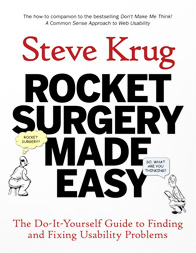
The purpose of this book is not to make you a usability professional or a usability testing expert; it's just to get you to do some testing.
Who is it for?
The book isn’t for professional usability experts. It’s more so aimed at people who don’t do usability testing, and tries to encourage you to start or do more by guiding you through the basic simple steps that are involved in low budget, but extremely useful, usability tests.
The cover doesn’t specifically imply that the book is about the web, but it is very much focused on websites and web applications.
If you work on a large web site or application, or design websites for a living, then you will find this book very useful.
What's in it?
- Why you need to perform tests
- What to test and how to test it
- How to recruit testers
- How to perform you own tests, with little to no budget
- A script for performing your own tests
- What to do with the results
Verdict
This is just what I needed to remind me of the important of usability testing. Krug’s book outlines simple usability tests that only need to be performed one morning a month with as little as 3 testers, but that will help you identify and prioritise key problems and user issues with your website.
With an easy to follow step by step guide, checklist and script, you’ll be sure to finish this book feeling like a usability pro.
Now you just need to put it into action!
Pull quotes
As a result, we end up designing for our abstract idea of users, based for the most part on ourselves.
...it's possible to detect serious usability problems very early in the development process...
Designers are often reluctant to show things that look unfinished...you will come across problems that you already know about, but there will also be surprises.
...there are many things you can learn by watching almost anyone use it.
The first step is to jot down a list of the most important tasks that people need to be able to do on your site.
A scenario provides some context ("You are...,""You need to...")
You can't tell them what to do or give them clues.
When fixing problems, try to do the least you can do.
Receive more design content like this to your inbox
I promise not to spam you. No more than one email per week.