Designers, ask your client 'why' five times

You may have heard the term “ask why five times”, a technique first used by Sakichi Toyoda at Toyota as part of their ‘lean manufacturing’ process.

You don’t necessarily have to do it five times, the point is to keep asking questions until you get down to the root of the problem, and explore various ways to solve that problem. Don’t just accept the first statement or request.

Clients don’t know what they need, that’s why they hired you

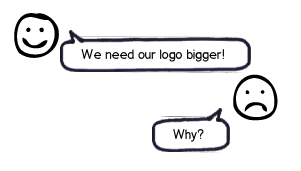
why.gif

As a web designer, you’re a problem solver, and it’s good practice to use this technique on your clients.

Here’s a basic example:

Client: We need a blog.

Designer: Why do you need a blog?

Client: Because our competitor has a blog.

Designer: Why does your competitor have a blog?

Client: So their users have a place to go to read about company announcements.

Designer: Why do users need a place to read about company announcements?

Client: Every so often they add features, like us, and they use the blog to announce those features. We plan to do the same.

Designer: Why do you need to announce new features?

Client: So users can use the new features.

Designer: Why would users want to use the new features?

Client: They’ll enjoy the product more, which should help customer retention.

Designer: Maybe you don’t need a blog. A blog will take quite a lot of effort and money to design, develop and maintain. How about in-app notifications for new features, call-outs that highlight new features, a monthly newsletter, using a Twitter account for announcements, or use a tool like Intercom? Or maybe you don’t need new features at all, and there’s a better way to keep your customers happy?

Client: Never thought of that. Which one can we have up and running by this afternoon?

Get to the root of the problem

Constantly asking why can sound annoying, but it should lead to healthy discussion about how to best solve the underlying issue.

In the end the you may come full circle and implement the initial suggestion, but make sure you understand the root of the problem and explore all possible solutions before time and effort is wasted.

Related articles


12 Appreciated Comments

  1. On the , Dimi said:

    Great thing to keep in mind, thanks for reminding us!

  2. On the , Jarod Online said:

    i really agree with this too. I’m glad you brought this up!

  3. On the , Tom Stutt said:

    Always worth knowing different techniques of how to deal with clients and get what they really need from them. Great little read.:)

  4. On the , Jeff Schoolcraft said:

    Hey Lee, awesome. In my space we call this “popping the why stack”. I included a link to this in my latest issue of Freelancing Weekly: http://freelancingweekly.com/issue-2

  5. On the , David Urmann said:

    Better to talk yourself out of some business then to have an unhappy client.

  6. On the , Brian Ostrovsky said:

    Great post. I love the 5-whys and I’m always amazed at how the fundamental assumption behind ‘it has to be x’ is ‘well, because’ and not something more significant.

    Sometimes people push back on this but what a value-add to help them understand something new about themselves or their own project.

  7. On the , Tom said:

    That’s really cool if your client plays along. What happens when they just say (by maybe “why” #2) “because I said so!” ??

  8. On the , Nick Sloan said:

    Just be sure to do it in a way that doesn’t make you sound like an annoying child. I’d probably feel a bit frustrated if I was on the business end of that script above. With that said, the idea behind this is essential. Good designers/developers execute their client’s instructions, great designers/developers execute their client’s goals.

  9. On the , Jeff Hyde said:

    I generally agree with this approach and have often used something like it with success in our work. Where we have tweaked this is with the use of the word “why”. In many ways “why” is a confrontational word that may put the person being asked on the defensive. In research circles, especially moderating and in-depth interviewing, we are trained to not use the word “why.” Instead, it is better to use more specific and less confrontational questions. For example, instead of saying ‘why do you need a bigger logo?’, you might ask ‘what will having a bigger logo help you accomplish?’ Yes this might sound overly sensitive, but if the goal is to get to the root of the issue, you may find this approach eases the conversation.

  10. On the , Nick Sloan said:

    Jeff, you hit the nail on the head. Thanks for more eloquently addressing what I fumbled through above.

  11. On the , Lee said:

    @Jeff and Nick: Very valid point. The example I used above definitely isn’t a word for word script I would follow. “What will having a bigger logo help you to accomplish?” reads a lot better, thanks Jeff.

  12. On the , Hello SEO Copywriting said:

    Very helpful article and an important reminder … not just for Designers. Anybody can easily turn into a passive service provider! Keep up the good work!

Have a comment? Tweet @leemunroe and I'll be glad to respond.